

Sunburn: Science-Backed Remedies and Common Myths
- July 19, 2026
- Beauty & Skin
Every summer, social media fills up with “miracle” remedies for sunburn. From toothpaste and yogurt to oils and vinegar, many people claim to have the fastest solution. However, temporary cooling or relief does not necessarily mean that a remedy is effective or safe.
Sunburn is an acute inflammatory reaction that occurs when the skin is exposed to excessive ultraviolet radiation. UV rays damage skin cells and trigger the release of inflammatory substances that cause redness, pain, warmth, and swelling.
No home remedy can reverse the UV damage that has already occurred. Treatment therefore focuses on relieving symptoms, protecting the affected skin, and allowing the body’s natural healing process to take place [4].
So, which remedies are actually supported by science?

Dr. Zena Kalaji
Writer
A dentistry student and wellness writer focused on how everyday preventive habits impact confidence and health.
Reviewed by Dr. Suleiman Atieh
Last updated: July 19, 2026
Table of Contents
This article is for educational purposes only and is not a substitute for professional medical advice.
1. Cooling the Skin: The First Line of Relief
A cool or lukewarm shower and cool compresses can help calm the skin and reduce pain and the sensation of heat.
Place a clean cloth soaked in cool water over the affected area for several minutes and repeat when needed.
Cooling helps lower the temperature at the surface of the skin and provides temporary pain relief, but it does not reverse the cellular damage caused by ultraviolet radiation. Cooling and pain management are basic first-aid principles for minor burns [3,4].
Important warning: Do not apply ice directly to sunburned skin. Extreme cold can cause additional tissue damage and may worsen irritation.
2. Aloe Vera Gel: A Soothing Option with Limited Evidence
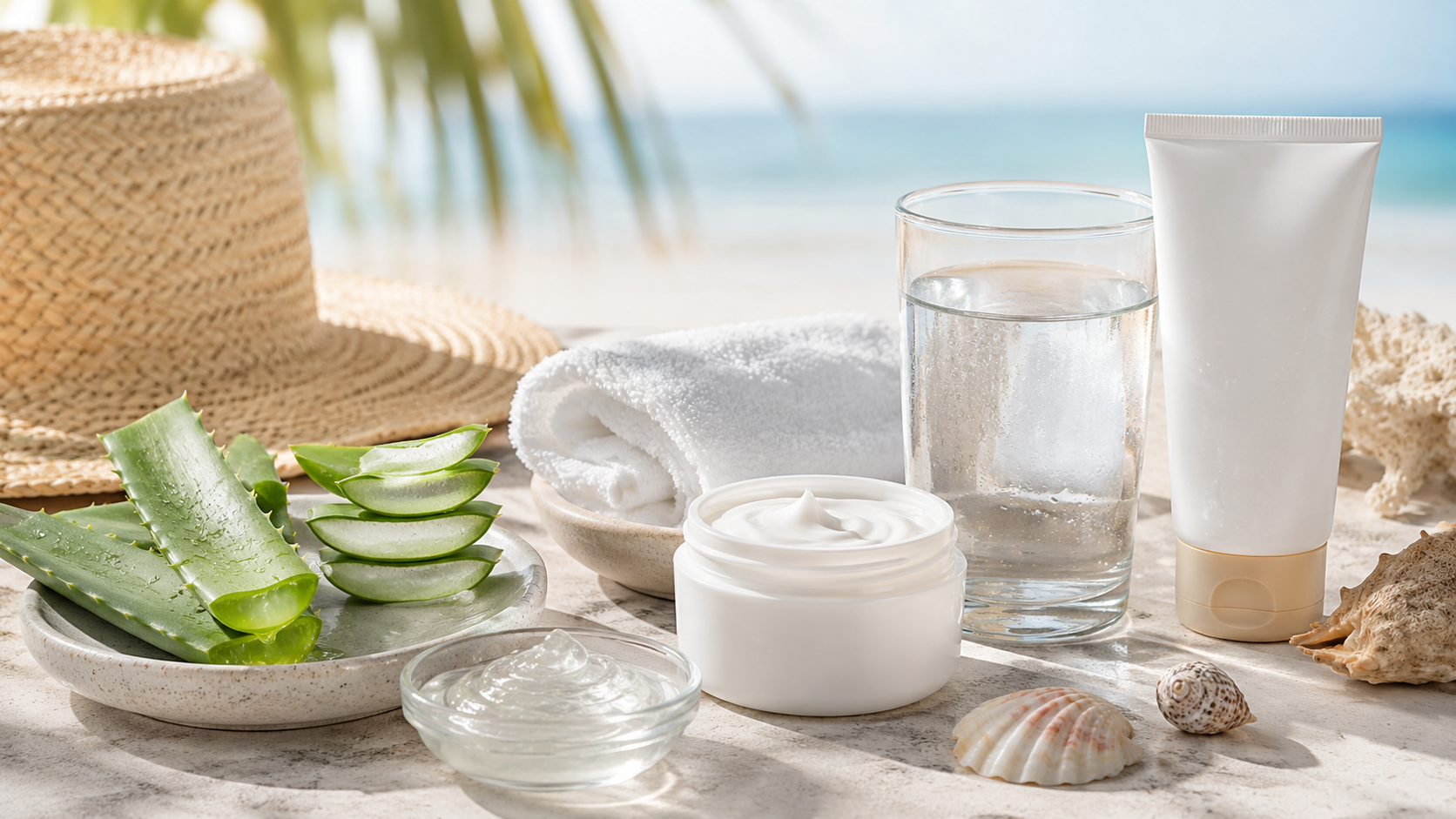
Aloe vera gel may help moisturize the skin and provide a cooling, soothing sensation. For this reason, it is commonly used to relieve mild sunburn symptoms.
A systematic review involving four clinical studies and 371 participants found that aloe vera use in first- and second-degree burns was associated with an average reduction in healing time of 8.79 days compared with conventional treatments.
However, these studies examined burns in general rather than sunburn specifically. The aloe vera preparations also differed between studies, and the overall quality of the evidence was limited. Aloe vera should therefore not be considered a miracle treatment or definitive proof of faster sunburn healing [1].
How to Use It
Choose pure aloe vera gel or a product that is free from fragrance and alcohol.
Apply a thin layer gently without rubbing the skin. The product may be kept in the refrigerator for an additional cooling effect.
Stop using it if it causes itching, burning, or irritation.
3. Pain Relievers and Nonsteroidal Anti-Inflammatory Drugs
Nonsteroidal anti-inflammatory drugs, such as ibuprofen or naproxen, may help reduce pain and inflammation associated with sunburn.
These medicines work by reducing the production of prostaglandins, which are substances involved in pain and inflammation [2,4].
However, they do not reverse UV damage, and strong evidence that they significantly shorten healing time is lacking. Their main benefit is symptom relief.
Important: Follow the dosage instructions on the medicine label and consult a pharmacist or doctor before use, especially if you have:
- A stomach ulcer or digestive problems.
- Kidney disease.
- An allergy to anti-inflammatory medicines.
- A bleeding disorder.
- Pregnancy.
- A prescription for blood thinners or other medicines.
Paracetamol may also be used for pain relief when anti-inflammatory medicines are unsuitable, provided that the correct dose is used and there is no medical reason to avoid it.
4. Hydration from the Inside and Outside
Large or severe sunburns may contribute to fluid loss through the damaged skin. Sunburn may also occur alongside prolonged heat exposure and sweating.
Drink enough water, particularly if you experience thirst, headache, dizziness, tiredness, or a dry mouth [4].
For external hydration, apply a gentle, fragrance-free moisturizer after cooling the skin or taking a shower. Moisturizers can help reduce dryness and peeling while supporting the skin barrier.
Products containing colloidal oatmeal or calamine may help soothe itching and discomfort.
Avoid using the following on sunburned skin:
- Fragranced products.
- Exfoliating scrubs.
- Acids.
- Retinol.
- Alcohol-based skincare products.
It is also better to avoid petroleum jelly and highly occlusive, greasy products while the skin is still hot during the early stage of the burn.
5. What About Hydrocortisone Cream?
Hydrocortisone and other corticosteroids are not generally recommended as routine treatments for sunburn.
Studies have produced inconsistent findings, and some medical references indicate that topical or oral corticosteroids do not provide a clear benefit after sunburn has already developed [4].
Do not apply hydrocortisone to large areas, open or blistered skin, the face, or a child’s skin unless advised by a doctor or pharmacist.
Popular Remedies That Are Not Supported by Evidence
Yogurt or Sour Milk
Cold yogurt may provide temporary comfort because of its low temperature, but there is no reliable clinical evidence showing that it treats sunburn or speeds up healing.
Food products are not sterile or specifically designed for use on damaged skin. Cool compresses and fragrance-free moisturizers are safer options.
Toothpaste
Toothpaste is not a burn treatment and does not cool the skin safely.
It may contain flavourings, abrasives, menthol, fluoride, and other ingredients that can irritate inflamed skin.
First-aid guidance recommends avoiding toothpaste and similar household products on burns.
Butter and Heavy Oils
Butter, olive oil, and coconut oil are not suitable first-aid treatments for a fresh sunburn.
Greasy products may create a layer over the skin without properly cooling it. They can also make the area more difficult to clean and assess [3].
After several days, once the skin has completely cooled and begins to feel dry or peel, a gentle moisturizer may be used. However, oils are not a substitute for appropriate early treatment.
Vinegar
There is no reliable evidence supporting the use of vinegar for sunburn.
Because vinegar is acidic, it may cause stinging and further irritation, particularly if the skin is blistered, cracked, or broken.
Topical Anaesthetic Creams and Sprays
It is generally better to avoid products containing topical anaesthetics such as benzocaine.
These ingredients may cause irritation or an allergic skin reaction in some people, and they do not treat the underlying UV damage [4].
What Should You Do If Blisters Appear?
Blisters may indicate that the sunburn is more severe than simple surface redness.
Do not intentionally pop intact blisters or peel away the skin covering them. The skin over the blister helps protect the area from infection.
If a blister breaks on its own, gently clean the area with water and mild soap, then cover it with a clean, non-stick dressing [4].
When Should You Seek Medical Care?
Seek urgent medical advice if any of the following occur:
- Blisters or severe swelling affect a large part of the body.
- Severe burns affect the face, eyes, hands, genital area, or a large area of skin.
- Fever, chills, nausea, dizziness, severe headache, or fainting occurs.
- Confusion, extreme weakness, dehydration, or signs of heatstroke develop.
- The pain becomes worse instead of gradually improving.
- Signs of infection appear, such as discharge, pus, increasing redness, warmth, swelling, or worsening pain.
- A baby or young child develops a severe sunburn.
- Blisters cover more than approximately 20% of an adult’s body, as significant burns may cause fluid and electrolyte loss and require specialist treatment [4].
First-Day Sunburn Care: Step by Step
For a mild to moderate sunburn involving redness and pain without widespread blistering, follow these steps:
- Leave the sun: Move indoors or into complete shade immediately.
- Cool the skin: Take a cool or lukewarm shower or apply cool compresses for several minutes.
- Dry gently: Pat the skin dry instead of rubbing it.
- Manage the pain: Use a suitable pain reliever after reading the instructions or consulting a pharmacist.
- Moisturize the skin: Apply aloe vera gel or a gentle, fragrance-free moisturizer.
- Drink water: Maintain adequate hydration throughout the day.
- Do not pop blisters: Leave them intact whenever possible.
- Wear loose clothing: Avoid tight fabrics and friction over the affected skin.
- Avoid further sun exposure: Protect the area until the skin has fully healed.
Conclusion
There is no instant treatment that can erase sunburn or reverse the skin damage after it occurs.
The most helpful measures are cooling the skin, drinking enough water, using a gentle moisturizer or aloe vera gel for comfort, and taking an appropriate pain reliever when needed.
Toothpaste, yogurt, vinegar, butter, and heavy oils are not medically proven sunburn treatments. Some of these products may worsen irritation or delay appropriate care.
Prevention remains more effective and safer than treatment. Repeated sunburn and intense ultraviolet exposure are associated with premature skin ageing and an increased risk of skin cancer.
Use a broad-spectrum sunscreen with an SPF of at least 30, reapply it every two hours and after swimming or heavy sweating, wear protective clothing, and limit direct sun exposure during peak hours [4].
FAQ
1. How long does sunburn last?
Mild sunburn usually improves within three to five days. More severe cases may take one to two weeks to heal.
2. What is the fastest way to soothe sunburn?
Cool the skin with a cool shower or compress, apply aloe vera gel or a fragrance-free moisturizer, drink water, and avoid further sun exposure.
3. Is aloe vera good for sunburn?
Aloe vera may help cool and moisturize the skin, but evidence that it speeds up sunburn healing is still limited.
4. Can I put ice directly on sunburn?
No. Direct ice can further damage the skin. Use a cool, damp cloth instead.
5. Should I pop sunburn blisters?
No. Leave blisters intact to reduce the risk of infection.
6. When should I see a doctor?
Seek medical care for widespread blisters, severe swelling, fever, dizziness, dehydration, worsening pain, or signs of infection.
References
- Maenthaisong R, Chaiyakunapruk N, Niruntraporn S, Kongkaew C. The efficacy of aloe vera used for burn wound healing: A systematic review. Burns. 2007;33(6):713–718. doi:10.1016/j.burns.2006.10.384.
- Dr. Oracle. How do Nonsteroidal Anti-Inflammatory Drugs (NSAIDs) affect sunburn healing? Published May 30, 2025. Accessed July 19, 2026.
- Hudspith J, Rayatt S. First aid and treatment of minor burns. BMJ. 2004;328(7454):1487–1489. doi:10.1136/bmj.328.7454.1487.
- Guerra KC, Crane JS. Sunburn. Updated October 29, 2023. In: StatPearls [Internet]. Treasure Island, FL: StatPearls Publishing; 2026. Bookshelf ID: NBK534837.
About the Author
A dentistry student and wellness writer focused on how everyday preventive habits impact confidence and health.
Dr. Zena Kalaji
Writer