

Tulsi: The Ancient Calm Herb Becoming a Modern Stress Ritual
- June 19, 2026
- Herbals & Natural Health
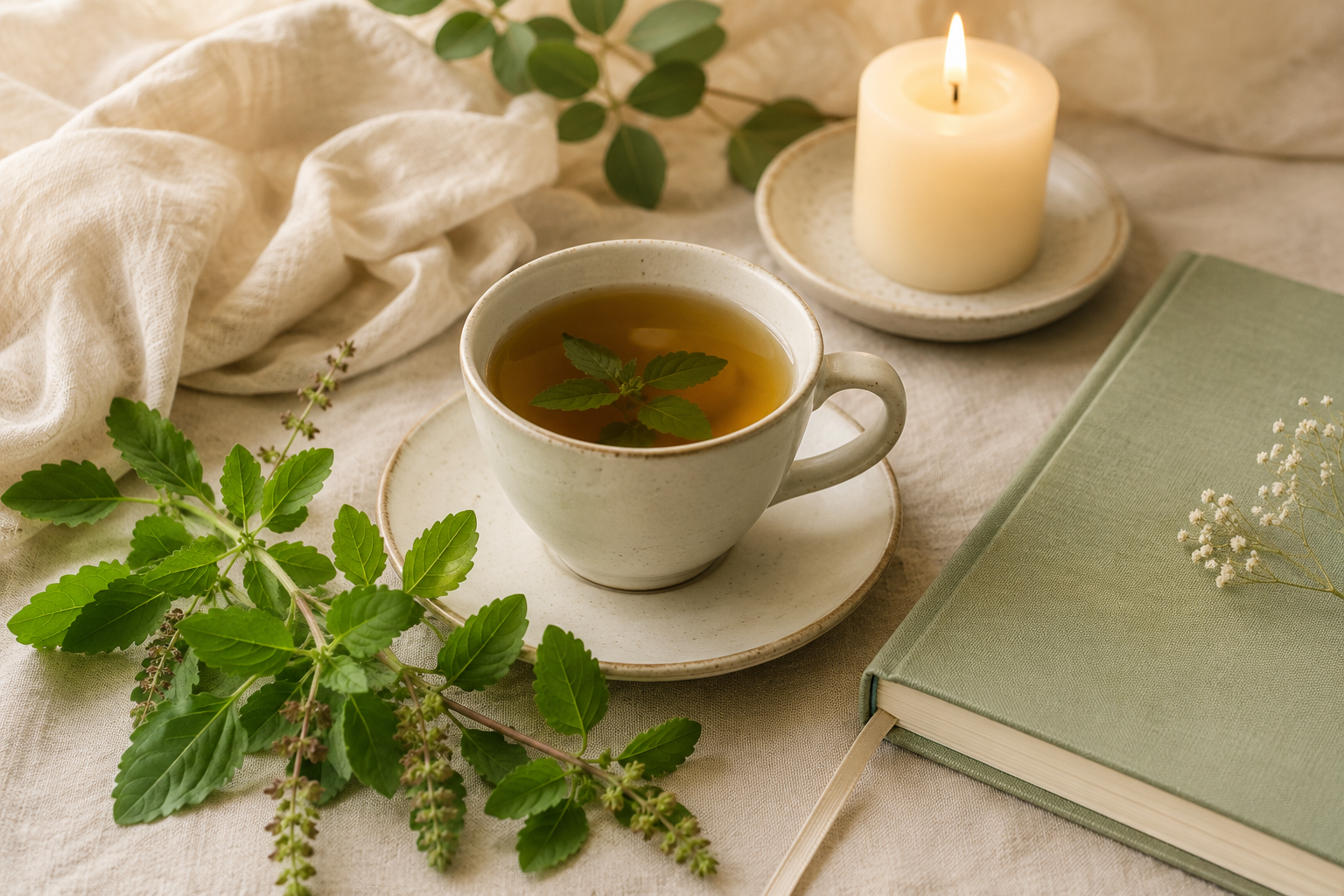
In a wellness world filled with nervous system regulation, adaptogens, calming teas, and evening rituals, tulsi is quietly becoming one of the most loved herbs for daily stress support.
Also known as holy basil, tulsi has been used for centuries in Ayurveda, where it is traditionally valued as a sacred herb connected to balance, clarity, and resilience. Today, it is moving from ancient herbal traditions into modern wellness routines: morning tea, post-work decompression, screen-free evenings, journaling rituals, and stress-support blends.
But is tulsi just another wellness trend, or does it actually have science behind it?
The answer is: tulsi is promising, but it should be used wisely. Research suggests that tulsi may support the body’s response to stress, mood, and sleep quality, but it is not a cure for anxiety, depression, burnout, or chronic stress. Think of it as a supportive ritual, not a medical solution. Human studies and reviews suggest possible benefits for psychological stress, but researchers also note that more high-quality research is still needed.

Dr. Suleiman Atieh
Founder
Dr. Suleiman Atieh is a pharmacist and founder of إلَيَّ, with a strong passion for healthcare marketing, brand strategy, and business development. He focuses on building meaningful healthcare brands that connect science, market needs, and modern communication.
Reviewed by Celine Abdallah
Last updated: June 06, 2026
Table of Contents
This article is for educational purposes only and is not a substitute for professional medical advice.
What Is Tulsi?
Tulsi is a medicinal herb from the basil family. Its botanical name is usually listed as Ocimum tenuiflorum or Ocimum sanctum, and it is commonly known as holy basil.
Unlike sweet basil, which is mostly used in cooking, tulsi has a stronger herbal, slightly spicy, peppery flavor. It is often consumed as tea, powder, capsules, tinctures, or included in adaptogen blends.
In Ayurveda, tulsi has long been described as a herb that supports balance in the body and mind. Modern research often discusses tulsi as an adaptogenic herb, meaning it may help the body respond more efficiently to different forms of stress.
Why Tulsi Fits the Modern Stress Ritual Trend
Modern stress does not always look dramatic. Sometimes, it looks like constant notifications, poor sleep, emotional overload, work pressure, decision fatigue, and feeling mentally “switched on” all day.
This is why people are becoming more interested in rituals rather than quick fixes. A ritual is not only about what you consume; it is about the pause you create around it.
Tulsi fits this trend because it can be used in a slow, calming way:
You make the tea.
You breathe while it steeps.
You step away from your screen.
You let your body understand that the day is slowing down.
Adaptogens and calming botanicals have been gaining attention in modern wellness conversations, especially for stress, sleep, mood, and nervous system support. Tulsi is often mentioned alongside herbs such as ashwagandha, saffron, rhodiola, and reishi, although the strength of evidence differs between ingredients.
Tulsi Benefits: What Science Suggests
1. Tulsi May Support Stress Resilience
One of the main reasons tulsi is trending is its connection to stress support.
A clinical review of human studies found that tulsi showed favorable outcomes in areas related to lifestyle-associated conditions, including psychological stress. However, the review also emphasized that more research is needed to clarify ideal dosage, forms, and the groups most likely to benefit.
Another randomized, double-blind, placebo-controlled trial studied a standardized holy basil extract in adults experiencing stress and poor sleep. After 8 weeks, the study suggested improvements in subjective and objective stress measures, as well as subjective sleep quality, though the authors stated that more research is needed to confirm sleep-related findings using stronger objective sleep measures.
Simple meaning: Tulsi may help some people feel more balanced under stress, but it should not be presented as a guaranteed anti-stress treatment.
2. Tulsi May Support Mood and Mental Calm
Stress is not only physical. It affects mood, patience, focus, motivation, and emotional regulation.
Some human studies included in reviews suggest that tulsi may have positive effects on stress-related symptoms and mental well-being. One study on a tulsi extract reported improvement in general stress symptoms compared with placebo over six weeks.
This does not mean tulsi treats anxiety or depression. It means tulsi may be part of a supportive wellness routine for everyday stress.
For serious, persistent, or overwhelming symptoms, professional mental health support is still the most important step.
3. Tulsi May Help Create a Better Sleep Routine
Tulsi is not a sedative in the same way some sleep aids are. Its value may come more from supporting stress balance and creating a calming routine before bed.
In the 2022 placebo-controlled trial, tulsi extract was associated with improved subjective sleep quality in stressed adults, although researchers noted that stronger objective sleep testing is needed before making firm sleep claims.
For daily life, tulsi tea can work beautifully as a sleep ritual cue: a gentle signal that the day is ending.
4. Tulsi Contains Plant Compounds With Antioxidant Activity
Tulsi contains various bioactive plant compounds that have been studied for antioxidant, anti-inflammatory, metabolic, and stress-related pathways. Reviews describe tulsi as a herb with multiple pharmacological actions, but many mechanisms still need more clinical research in humans.
This is important because wellness content often overpromises. Tulsi is interesting because it has both traditional use and emerging research, but it still needs careful, responsible language.
Tulsi Tea: The Easiest Way to Start
For most people, tulsi tea is the gentlest and most ritual-friendly way to experience the herb.
It can be used:
- In the morning instead of a second coffee
- After work to transition out of “productivity mode”
- Before journaling or meditation
- In the evening as part of a screen-free wind-down
- During stressful weeks as a grounding habit
The point is not only the tea. The point is the pause.
A simple tulsi ritual could look like this:
Boil water.
Steep tulsi tea according to the product instructions.
Sit away from your phone for five minutes.
Take slow breaths.
Ask yourself: “What do I need less of today?”
That small ritual can turn tulsi from a drink into a calming anchor.
Tulsi vs. Ashwagandha: What’s the Difference?
Tulsi and ashwagandha are both commonly called adaptogens, but they do not feel the same in a routine.
Tulsi is often used as a lighter daily herb, especially as tea. It feels more ritual-based, gentle, and easy to add to a lifestyle routine.
Ashwagandha is usually taken as a supplement and is often positioned for stress, cortisol, and sleep support. It may be stronger for some people and may also come with more cautions depending on health status and medications.
For ILAYA-style wellness, tulsi is a beautiful herb to discuss because it is approachable. It does not need to be framed as a “power supplement.” It can be framed as a daily calm ritual.
Who Should Be Careful With Tulsi?
Tulsi is natural, but natural does not always mean safe for everyone.
According to medical reference sources, holy basil may not be suitable for people who are pregnant, trying to become pregnant, or breastfeeding, because safety data is limited and animal research has raised concerns. It may also interact with blood clotting, surgery risk, thyroid hormone levels, and certain medications.
Be careful with tulsi if you:
- Are pregnant
- Are breastfeeding
- Are trying to conceive
- Take blood-thinning medication
- Have a bleeding disorder
- Have thyroid disease
- Are scheduled for surgery
- Take medication for blood sugar, blood pressure, or chronic conditions
- Are using it for a child or teenager
A healthcare professional should be consulted before using tulsi supplements, especially capsules, extracts, or concentrated forms.
How to Choose a Good Tulsi Product
When choosing tulsi, look for:
1. Clear labeling
The product should mention tulsi, holy basil, or Ocimum tenuiflorum / Ocimum sanctum.
2. Simple ingredients
For tea, choose blends without unnecessary artificial flavors or excessive sweeteners.
3. Trusted brands
Choose brands that provide quality testing, transparent sourcing, and clear instructions.
4. Form that matches your goal
Tea is best for rituals. Capsules or extracts are more concentrated and should be used more carefully.
5. No exaggerated claims
Avoid products that promise to “cure anxiety,” “balance all hormones,” or “detox the body.” These claims are too strong and not responsible.
A 5-Minute Tulsi Stress Ritual
Here is a simple ritual to include in your daily wellness routine:
Step 1: Make tulsi tea
Use the instructions on the product label.
Step 2: Put your phone away
Even five minutes without scrolling can change the feeling of the ritual.
Step 3: Breathe slowly
Try inhaling for four seconds and exhaling for six seconds.
Step 4: Release one thought
Write down one thing that is taking too much mental space.
Step 5: Choose one soft action
Stretch. Wash your face. Read one page. Sit quietly. Sleep earlier.
This is where tulsi becomes more than a herb. It becomes a signal of care.
The Bottom Line
Tulsi is not new. It is ancient. But the way we are using it today feels very modern.
In a world where many people are tired, overstimulated, and emotionally overloaded, tulsi offers something simple: a warm cup, a pause, and a reminder to slow down.
Science suggests that tulsi may support stress response, mood, and subjective sleep quality, but the evidence is still developing. The safest way to talk about tulsi is not as a cure, but as a supportive wellness ritual.
For everyday stress, tulsi can be a beautiful part of a calming lifestyle routine: gentle movement, balanced nutrition, better sleep habits, emotional boundaries, and mindful pauses.
Sometimes, calm does not start with a huge life change.
Sometimes, it starts with a cup of tea.
FAQ
Is tulsi good for stress?
Tulsi may help support the body’s response to stress. Some human studies suggest benefits for stress symptoms, but more research is needed before making strong medical claims.
Is tulsi the same as holy basil?
Yes. Tulsi is commonly known as holy basil. Its botanical name is usually Ocimum tenuiflorum or Ocimum sanctum.
Can I drink tulsi tea every day?
Many people use tulsi tea as part of a daily routine, but it may not be suitable for everyone. People who are pregnant, breastfeeding, trying to conceive, taking blood thinners, managing thyroid disease, or using chronic medications should ask a healthcare professional first.
Does tulsi help with sleep?
Tulsi may support sleep indirectly by helping with stress and relaxation. A clinical trial suggested improved subjective sleep quality in stressed adults, but more objective sleep research is still needed.
What is the best time to drink tulsi tea?
Tulsi tea can be used in the morning for a calm start, in the afternoon as a stress pause, or in the evening as part of a wind-down routine.
Is tulsi safe during pregnancy?
Tulsi supplements are not generally recommended during pregnancy or while trying to conceive unless approved by a healthcare professional. Safety data is limited, and some animal research has raised concerns.
References
- Jamshidi N, Cohen MM. The Clinical Efficacy and Safety of Tulsi in Humans: A Systematic Review of the Literature.
- Lopresti AL et al. A randomized, double-blind, placebo-controlled trial investigating Ocimum tenuiflorum extract on stress, mood, and sleep.
- Cohen MM. Tulsi — Ocimum sanctum: A herb for all reasons.
- Merck Manual / MSD Manual. Holy Basil safety and interactions.
About the Author
Dr. Suleiman Atieh is a pharmacist and founder of إلَيَّ, with a strong passion for healthcare marketing, brand strategy, and business development. He focuses on building meaningful healthcare brands that connect science, market needs, and modern communication.
Dr. Suleiman Atieh
Founder